
Why Growth Feels Harder Than It Should
Why growth often becomes harder as companies scale

Build the marketing function your business actually needs—without guesswork, over-hiring, or underperforming results.
Most executive teams don't need to be convinced that marketing matters. But many are still unclear about how to structure it effectively.
As planning season approaches, the same questions surface: Should we hire? Outsource? Cut programs or expand the tech stack? Marketing isn't just a budget line item — it's a business function. And if that function isn't designed to align with your goals, stage of growth, and market realities, no amount of spend or talent will produce sustainable results.
This guide helps executive leaders make informed marketing decisions across three critical dimensions: People. Programs. Platforms.
The goal isn't to provide a one-size-fits-all model—it's to help you build the right structure for your business.
Whether you're looking to reassess your team model, recalibrate spend, or bring stronger alignment between marketing and revenue, this guide provides the strategic context and practical tools to support more confident planning.
The pace of change in marketing has accelerated, but if you aren't getting the fundamentals right, you won't reap the benefits. Leaders are navigating the complexities of zigzagging buyer behaviors, evolving sales cycles, and the impact of AI on team structure, skills requirements, and marketing efficiencies. You want to move faster and do more, but speed without the right strategy will not pay off.
The AI landscape is a frenzy of new tools. A few improve productivity, but all require experienced oversight. The promise of AI is real, but it does not replace the need for great positioning, messaging, or campaign strategy, for example. The most effective use of AI comes from teams that know how to apply it in context.
To make matters more complex, FTE salaries continue to rise. The average salary for a senior-level marketer has increased significantly over the past two years, and full-time hires now represent a substantial long-term commitment. Yet, many companies continue to treat marketing as a single-hire problem rather than a cross-functional investment.
Average marketing spend as a % of revenue in 2025, forcing sharper capability trade-offs.
Gartner CMO Spend Survey
Stakeholders involved in complex B2B purchase decisions. Value framing content significantly increases deal quality.
Gartner
Of existing skill sets will become outdated between 2025 and 2030, reshaping marketing team composition.
World Economic Forum
Marketing still requires clarity. It still depends on alignment with sales, products/services, and buyers. It still needs the right balance between planning and execution. These principles matter more than ever in an environment where budgets get scrutinized and results are expected quickly.
The remainder of this guide is designed to help you assess your current structure, identify gaps, and develop a model that is well-equipped to support your growth strategy in the coming year (and beyond).
Most marketing underperformance issues are not tactical in nature, but instead are structural. Companies invest in content, websites, or campaigns without first considering whether they have the right roles and capabilities to execute consistently.
There are several common models for marketing resourcing. Each has trade-offs in terms of cost, control, flexibility, and alignment with leadership:
Salaried employees across marketing functions
Independent specialists on demand
External firm delivering campaigns or channel execution
Cross-functional team with a strategic lead integrated into client operations
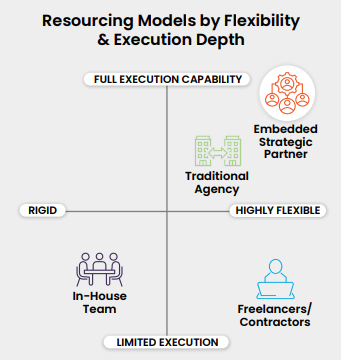
The right marketing team structure isn't about choosing between "in-house" or "outsourced." It's about understanding what each model enables—and where its limitations lie. Every option offers trade-offs in terms of flexibility, depth of execution, strategic continuity, and long-term scalability. This quadrant visual maps four common team models across two critical dimensions: execution focus and structural flexibility.
Use this model to determine where your current approach fits—and whether it aligns with your 2026 goals.
The biggest mistake? Hiring one marketing generalist and expecting full-funnel performance.
Rather than fixating on resourcing labels, leaders should ask:
The most effective companies build their marketing function like a system — with defined roles, feedback loops, and accountability across teams.
Once you've selected a team model, the next question is: what roles do you actually need? The answer depends on where your company is in its growth journey—and where it's headed.
Hiring a whole in-house team too early leads to bloat. Expecting one person to "own marketing" at $20M in revenue is unrealistic. Instead of hiring reactively, structure your team around the core functions needed to deliver on your growth strategy.
This chapter outlines how team requirements evolve by stage and how to assess the capabilities your organization truly needs.
At this stage, marketing is often a light-touch approach encompassing content, basic campaigns, and sales enablement materials. Execution is reactive and disconnected from a larger growth strategy.
At this stage, companies need to move from founder-led messaging to structured campaigns. Marketing supports sales velocity, fuels the pipeline, and drives channel performance. Programs are running—but not always integrated.
As marketing complexity increases, so does the need for specialized skills. Channel-specific execution, operations, and analytics become essential. Marketing leaders at this stage must focus on scale, optimization, and data visibility.
Once you've outlined the structure and roles you need, the next question becomes: How do we fund them?
Effective marketing isn't about a single budget number—it's about knowing where that number needs to go. The most successful plans align spend across three core areas:
Too often, companies overcommit in one area and underfund the others. A full-time hire without a program budget won't deliver results. A tech stack without execution resources sits unused. A strong program without strategic leadership leads to inefficiency.
This chapter offers a framework for aligning your investment intentionally—not equally— across people, programs, and platforms. It also includes current benchmarks, sample budget splits, and common planning pitfalls to avoid.
The goal is to help you build a budget that fuels growth, not just activity.
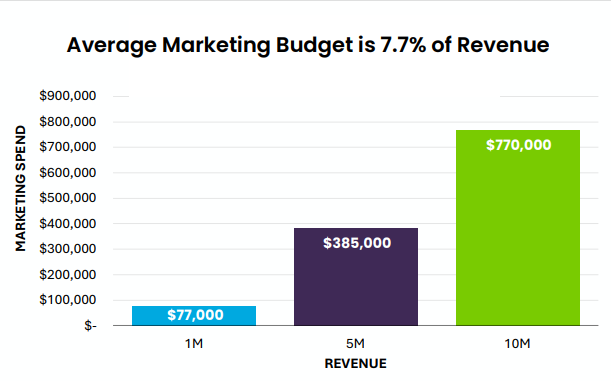
The average marketing spend across industries in 2025 remained at 7.7% of revenue, encompassing people, technology, and advertising. Yet budgets in both the "IT and business services" and "Tech services and products companies with over $250M revenue" industries decreased, according to Gartner.
With a constant need to spend wisely—whether budgets are decreasing, remaining flat, or increasing—breaking down spending by people, programs, and platforms will help leaders understand and more clearly assess their needs.
Team hiring — in-house, agencies, and contractors
Campaigns, content, demand generation, and events
Martech and analytics tools that enable scale
| Category | Early-Stage (<$10M) | Mid-Market ($10M–$50M) | Growth-Stage ($50M+) |
|---|---|---|---|
|
People (~43%)
|
$165,550 | $1,655,500 | $16,555,000 |
|
Programs (~35%)
|
$134,750 | $1,347,500 | $13,475,000 |
|
Platforms (~22%)
|
$84,700 | $847,000 | $8,470,000 |
| Total Budget (7.7% of Revenue) | $385,000 | $3,850,000 | $38,500,000 |
When it comes to setting marketing budgets, it's more important to be deliberate with your spend than it is to have the highest budget possible. Oftentimes, smaller marketing budgets can even lead to greater intention, since leaders will feel like they can't simply throw money at a "problem." In fact, that problem may be solved by reallocating resources from one category to another.
To land on the right budget for your team, you must first consider your company's current stage and size.
We recommend that you consider the following key aspects to better understand who and when to hire:
| Consideration | Early-Stage | Mid-Market | Growth-Stage |
|---|---|---|---|
| Company Stage & Scale | Rely on agencies/contractors for flexibility, breadth of skills | Core in-house team with targeted agency/contractor partnerships | Majority in-house; agencies for scale, niche expertise |
| Core vs. Specialized Capabilities | Outsource specialized skills; bring on in-house generalist(s) | Build an in-house team for core roles (brand, demand gen when ready with Sales) | Most core, some specialized roles in-house; agencies for innovation, overflow |
| Flexibility vs. Control | Maximum flexibility working with agencies/contractors | Balanced, with in-house and agency resources | Control via large in-house teams; agencies provide scalability when needed |
| Speed & Expertise | Faster ramp, access to proven playbooks via agencies | Combination (build institutional knowledge in-house, with speed and expertise from agencies) | Agencies to inject fresh thinking when needed |
| Budget Efficiency | Avoid salary overhead through external partners | Optimize between in-house for budget efficiency, agencies for high-skill/more expensive projects | In-house lowers long-term cost per output; agencies used selectively |
| Integration with Tech & Programs | Agencies can provide executional support for martech | In-house team ensures martech is used; agencies plug gaps | Large in-house teams fully leverage martech; agencies for campaign spikes/advanced specialties |
Of course, the decision to bring on an external agency or contractors for marketing support does not always fit neatly into the buckets above. Many early-stage companies will outsource to meet their marketing needs until their day-to-day requirements are sufficiently fleshed out to hire select in-house resources, while mid-market and enterprise companies sometimes opt to maintain consistent agency support in larger capacities.
The final determination for a "people" budget should not be made in a silo—it's important to consider program and platform needs in conjunction, always with an understanding that marketing is an ongoing investment.
As AI tools continue to evolve, we believe core marketing teams—whether in-house or external—will decrease in size by 30–40% over the coming years, with AI assuming a significant portion of junior execution roles. Responsibilities like data analysis, analysis and campaign monitoring will be offloaded to AI tools, while the need for marketing strategists and those who can effectively manage and direct AI will increase.
When budgeting for paid programming, this particular spend should be treated as a variable growth lever—that is, you should scale the dollars spent up or down depending on revenue goals, lead gen goals, and market conditions.
Paid marketing programs can take many different forms, from digital advertising via Google Ads, LinkedIn Ads, Meta Ads, or retargeting platforms, to trade show booths, event sponsorships, or sponsored content in industry outlets. Using a mix of these programs, and how you prioritize them, will often depend on several factors:
| Consideration | Budget Allocation |
|---|---|
| Business Objectives & Growth Targets |
|
| Sales Cycle & Industry |
|
| Channel Strategy |
|
| Measurability & ROI |
|
Based on what we've already seen, we expect AI to shift program and campaign planning to be exponentially more personalized and predictive, with the ability to update program assets in both messaging and creative in real-time to meet buyers along their journeys.
In a crowded cybersecurity space, BotRx needed a way to stand out as a credible SaaS startup.
Magnetude created a strong visual brand and messaging program to launch BotRx at RSA, scaling from events to content to PR.
Named a top startup at RSA. Rapid lead gen ramp-up, media coverage in Dark Reading and Security Magazine.
Marketing technologies are powerful tools that should complement sales platforms. With the right investment, you can have accurate visibility into all sales and marketing efforts. To determine ideal spend for martech, we've identified key considerations below:
| Consideration | Budget Allocation |
|---|---|
| Business Objectives & Growth Goals |
|
| Company Size & Stage |
|
| Current Tech Stack & Integration Needs |
|
| Team Capacity & Adoption |
|
| Scalability & Flexibility |
|
In the realm of platforms and tools, we will likely see the biggest shift—from disparate systems (think your current CRM, CMS, social scheduler, creative suite, and more) to integrated and heavily consolidated AI-native martech. Robust asset management systems will also become more critical, for both storing AI-generated creative assets and tracking their performance.
A well-designed marketing function delivers more than just campaigns — it delivers alignment, accountability, and measurable progress toward business outcomes. When marketing underperforms, it's rarely due to a lack of effort. More often, it's a structure problem.
When these issues persist, growth stalls. Worse, marketing can become a cost center rather than a growth enabler.
The right marketing structure isn't about size. It's about fit—for your goals, your team, and your stage. Done right, structure becomes a multiplier.
An internal generalist was stretched across too many functions. Campaigns were inconsistent and sales was generating its own collateral.
Brought in an embedded marketing team with a strategic lead and structured responsibilities around demand gen, content, and analytics.
4x increase in MQLs, 40% faster campaign cycle time, and aligned monthly reporting between sales and marketing.
Marketing spend had increased, but visibility into performance was limited. No consistent strategy between paid programs and internal teams.
Realigned structure to include a demand gen manager and external content partner. Shifted budget from unused platforms to executional support.
Increased lead quality, reduced CAC by 30%, and eliminated unused tool spend.
The most successful companies don't just set a marketing plan once a year and hope it holds. They treat it as an ongoing process of aligning resources with outcomes. In a landscape defined by shifting buyer behavior, rising costs, and fast-moving AI disruption, the right structure isn't a luxury; it's a leadership tool. It gives executives the visibility to see what's working, and the flexibility to adapt when it's not.
This final chapter provides a clear and actionable way to assess your marketing structure, whether you're hiring, reallocating your budget, or rethinking your model altogether. By answering a set of diagnostic questions, you'll gain the clarity needed to make smart, intentional decisions that move your business forward.
For companies that treat planning as an iterative discipline, the flywheel represents the ongoing nature of marketing structure and budget alignment.
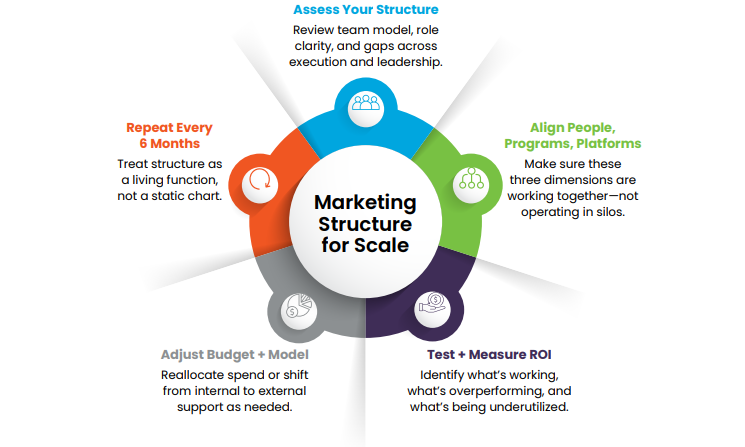
Why this works: The flywheel emphasizes continuous planning and structure evolution—not one-time fixes. It also reinforces the idea that structure is a leadership discipline.
Use these questions in quarterly planning, budgeting cycles, or at any structural inflection point.
The companies that thrive won't be the ones that spend the most — but the ones that structure their marketing intentionally, align it to revenue outcomes, and adapt as the environment changes.
This roadmap isn't your final plan—it's the foundation for smarter, more aligned decisions throughout the year.